
| Assignment Brief | |
| BMM5552: People Management | |
| Assignment type | Individual Report |
| Learning outcomes (Please see module Handbook for all learning outcomes) | By the end of this module, the student should be able to: Appraise the effectiveness of a range of people management models, theories, and concepts, including those dealing with setting up teams.Recognise the role of the personnel and HRM specialists in public and private organisations.Demonstrate the ability to work within a team; and reflect on your personal skills and areas for development.Analyse and present complex information from research. |
| Weighting: | 100% |
| Word Count or Equivalent | 3,000 words |
| Submission deadline: | This Week (12:00pm) |
| Post date: | Feedback will be available on Moodle 15 days after the submission date (excluding national holidays, staff sickness and annual leave). |
Completing Your Assignment
What is required in this assignment?
People management literature shows that effective people management is essential for organizational success, as it leverages the potential of employees to contribute to the attainment of strategic objectives (Lepak & Gowan, 2010).
You are required to critically discuss, analyse, and evaluate approaches to people management within an organisational context. This should be achieved by applying relevant theories, models, and approaches studied in this module to an organisation and/or manager of your choice, in order to contextualise your analysis, critique, arguments, discussion, and conclusions
Your assignment may include the following structure:
1. Introduction and Context (~400 words)
- Overview: Define people management and the role of HR in organisational success.
- Organisational Context: Briefly describe the chosen organisation/manager (industry, size, key challenges).
- Purpose and Scope: Outline the aim of the report and what the report addressed.
2. Theoretical Framework (~700 words)
- Key Theories: Select relevant theories (leadership theories, ethical theories, motivation theories, learning and development theories, diversity…etc), and justify your choice of these theories, supported by academic sources. Aim to discuss at least three relevant theories.
- Critical Evaluation: Briefly assess the strengths and limitations of the chosen theories.
3. Application of Theories, Analysis, and Discussion (~1,500 words)
- Theory in Practice: Apply the selected theories to real-world practices within the chosen organisation or by the specified manager.
- Critical Analysis: Evaluate the effectiveness of people management approaches, considering factors like culture, leadership, and external influences.
- Integration of Research: Use academic sources and examples to support your analysis.
- Personal Reflection: Reflect on your teamwork experiences (in school or in your workplace) and areas for personal development.
4. Conclusion and Recommendations (~400 words)
- Summary: Recap key findings from your analysis.
- Recommendations: Offer practical, evidence-based suggestions for improving people management for your chosen organisation or people manager.
5. References
- List all cited academic and organisational sources in the required referencing style.
6. Appendices (if needed)
- Include supplementary materials like data, charts, or documents supporting your analysis.
Word Count: The word count for written assessments is as noted above, +/- 10% is allowed. This does not include the references list, bibliography list, or appendices list. If you exceed the word limit, any work after the allowed wordcount will not be marked. Whilst you are not penalised for being under the word count, work that is substantially under the word count will be more limited in meeting the programme learning outcomes.
Feedback Date: Feedback will be available on Moodle 15 days after the submission date (excluding national holidays, staff sickness and annual leave).
Referencing: You are required to use the American Psychological Association (APA) referencing style. Please visit the Library guide here for more information: APA 7th Referencing (leedstrinity.ac.uk).
All modules will include a session which unpacks the assessment brief, providing opportunities for you to clarify any questions you have about the assessment task. The assessment criteria and rubric will be examined in these sessions to support your understanding of the expectations of the task(s). Your module tutor will provide generic feedback on what a good assessment looks like, common misconceptions, pitfalls, construction of arguments, format, spelling and referencing. You are encouraged to bring selected sections of your work or a one-page plan to assessment support sessions for verbal feedback and where appropriate, peer discussion. Your module tutor will not give any indication of mark or classification for any draft work presented. Where you have received previous feedback, your tutors will encourage you to reflect on this to support your acquisition of knowledge and academic skills development. Feedback on a full draft of an assessment for submissions, prior to the submission deadline, is not normally permitted.
Use the Assignment Preparation Checklist on the last page before you submit your work.
Extension to the submission deadline
An extension to the assessment submission allows students extra time beyond the original deadline to complete their work. Each student is granted two extension opportunities of 5 days each per academic year. If you need more time to finish an assignment, you can request an extension by contacting the Registry Team at registry@wic.ac.uk. This will give you an additional 5 working days to submit your assignment. Be sure to submit the completed extension form at least 48 hours before the original deadline, as late requests will not be accepted.
Mitigating/Extenuating Circumstances
Students who miss an exam or cannot meet an assessment deadline due to illness or other valid reasons must follow the Mitigating/Extenuating Circumstances Policy to retain their first attempt and avoid penalties. They should promptly inform the Registry, Year lead, assessment officer, or Student Support Team and complete the Mitigating/Extenuating Circumstances form, providing reasons and evidence of the extenuating event and draft work. Poor planning, time management, or work/caring duties are generally not accepted as valid reasons. If approved, students can submit their assignments during the re-submission period, which will count as their first submission.
Academic Integrity
Waltham International College, in partnership with Leeds Trinity University, is committed to fostering a diverse and inclusive environment where students are expected to act with integrity, self-discipline, and respect in all academic and professional activities. Academic Integrity refers to conducting scholarly work in an open, honest, and responsible manner. Students must respect the intellectual property of others by properly attributing and acknowledging sources. Through authentic learning, students are encouraged to develop independent thought and analysis, ensuring the academic standards and value of the University’s awards. It is the responsibility of students to ensure their work upholds these standards.
Academic Misconduct
Academic misconduct involves any form of dishonesty in academic work, whether intentional or unintentional, that undermines the integrity of assessments. Any suspected misconduct will be investigated, and common types of misconduct include:
- Poor Scholarship: Incorrect referencing or misunderstanding of academic standards.
- Self-Plagiarism: Reusing one’s work without proper acknowledgement.
- Plagiarism: Using others’ work without citation.
- Collusion: Unauthorized collaboration on individual tasks.
- Fabrication: Falsifying data or manipulating academic documents.
- Research Misconduct: Failing to conduct ethical research.
- Impersonation: Allowing someone else to assume your identity for academic gain.
- Contract Cheating/Use of AI: Seeking assistance from a third party or using AI tools to complete your assignment.
Waltham International College and Leeds Trinity University are dedicated to investigating all instances of academic misconduct and applying appropriate disciplinary measures when necessary.
Use of Generative Artificial Intelligence in this module
- You may use generative AI such as ChatGPT to assist you in the process of undertaking the assessment in the following ways: brainstorming, research, planning, feedback, editing.
- All use of generative AI must be explicitly acknowledged, and any artificially generated content (e.g. images) explicitly labelled, with the source of the AI tool referenced using current APA referencing conventions You can find further guidance on the library website on their AI webpage).
- In submitting your assignment, you agree to disclose the extent to which you have used generative AI in preparing this work, and include evidence of your AI use in your appendices (e.g. dated screen shots of your use of this tool or copy and paste your AI chat into Word).
- Failure to disclose your generative AI use may result in a 0 for your assignment and a referral for academic misconduct (see the Student Academic Misconduct Policy under Essential Info in the MyLTU app).
You are required to include one of the following statements on your assignment:
Either:
- This assignment used generative AI in the following ways for the purposes of completing the assignment (choose 1 to 5 of the following): brainstorming, research, planning, feedback, editing.
Or:
- This assignment did not use generative AI for the purposes of completing the assignment.
Resources
The library holds several editions of many of the books you will find useful, but references are given here only for the most recent editions. Access to catalogues can be found on the ‘My LTU app’ or via the website: https://lib.leedstrinity.ac.uk
Core resources
1. Moodle Page for the Module: https://moodle.leedstrinity.net/course/view.php?id=1017
2. Library: https://lib.leedstrinity.ac.uk and phone number 0113 2837244
Core texts:
- Armstrong, M., & Taylor, S. (2020). Armstrong’s handbook of human resource management practice (15th edition). KoganPage
- Torrington, D., Hall, L., Taylor, S. & Atkinson, C. (2017) Human resource management, 10th ed., Harlow: Pearson.
- Wilkinson, A., Redman,T. & Dundon, T. (2017) Contemporary human resource management: text and cases, 5th ed., Harlow: Pearson.
- Bratton, J. & Gold J. (2017) Human Resource Management: Theory and Practice London, Palgrave.
Recommended texts:
- Furnham, A. (2008) People management in turbulent times, London, Palgrave Macmillan.
- Kouzes, J. & Posner, B. (2008) The Leadership Challenge, London: Jossey-Bass.
- Thompson, N. (2013) People management, London: Palgrave MacMillan
Additional Resources
We recommended that you read widely on the subjects being covered, and I personally believe it best to find the books that work for you, i.e., ones that you find easily accessible, and which meet your own individual learning style and needs. Additional appropriate and current resources will be introduced and posted to Moodle during the course of study on this module.
Useful Websites
- TED – https://www.ted.com/topics
- CIPD – CIPD The Professional Body for Human Resources and People Development
- People Management – People Management homepage
Useful Journals
- Journal of Human Resource Management
- Human Resource Management Journal – online via Wiley Human Resource Management Journal – Wiley Online Library]
- International Journal of Human Resource Management – online via Business Source Premier
- The International Journal of Human Resource Management.
Assessment Criteria
Your work will be assessed in line with the generic marking criteria for undergraduate assessments (see below). In common with many Universities, Leeds Trinity University employs categorical marking to all assignments and assessments. Marks are therefore awarded as follows: -
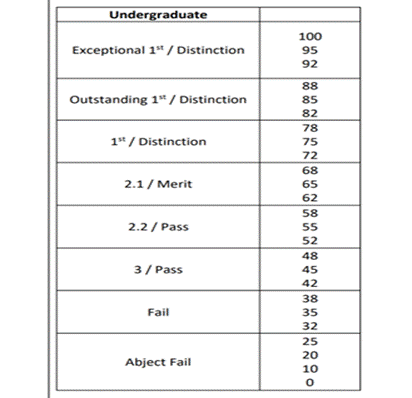
Work assessed as being of a first or outstanding first-class standard typically: -
- Answers all parts of the assessment task.
- Demonstrates deep and nuanced knowledge and understanding of contemporary developments at the forefront of the discipline(s) (i.e., theories, models, approaches, schools of thought, and research findings).
- Underpins throughout, with purposeful and systematic use of primary and/or secondary sources of literature and evidence. Shows sustained, clear, independent, and original thought, and a well thought out methodological approach.
- Includes extensive, selective, and evaluative use of research evidence, which is rigorously applied.
- Offers a sophisticated and highly nuanced argument and structure, which is perceptive, insightful, and original.
- Highly professional, succinct, concise and to the point writing, which is highly appropriate to the audience and discipline.
- Offers original, detailed, and perceptive analysis; rigorous and sustained critical evaluations and appraisals; and convincing, well-argued conclusions and recommendations (if appropriate to the assignment/assessment task). 8. Flawless referencing and use of other academic conventions.
Weaker work assessed as being a failure is often characterised by:
- Failing to read and understand all parts of the question/task.
- Failing to answer all parts of the question/task.
- Failing to underpin throughout with theory &/or academic sources.
- Demonstrating limited understanding of key concepts, issues, and debates, and showing little awareness of the complexity of the discipline.
- Demonstrating limited or inappropriate selection and use of primary and/or secondary sources of evidence, and little application of research evidence to underpin throughout.
- Offering a flawed basic argument or structure, with flawed or inaccurate writing, with limited awareness of the discipline, and the audience it is written for.
- Offering an overly/mainly descriptive approach, with little analysis and evaluations; with inconclusive unbalanced arguments; inadequately/weakly supported conclusions.
- Inaccurate flawed referencing, and poor use of other academic conventions.
- Using essay writing services, plagiarising, and using non-academic and non-peer reviewed sources of literature and evidence.
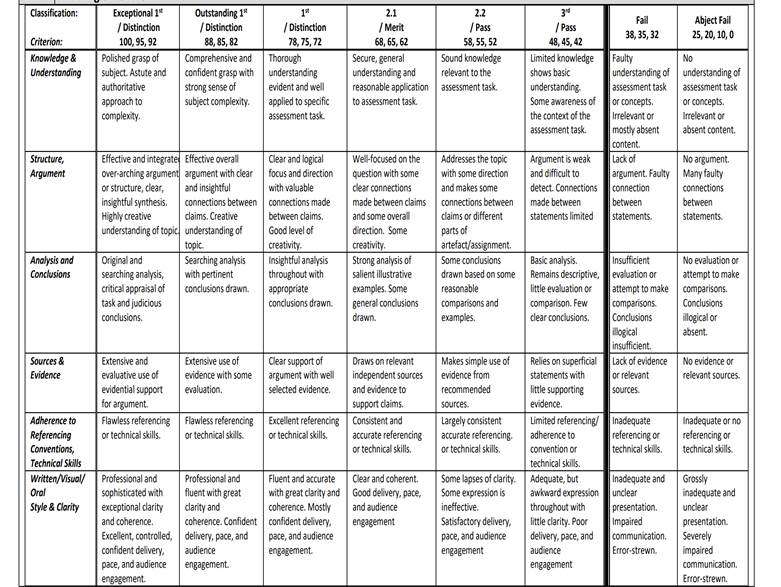
Generic descriptors to inform marking criteria for academic undergraduate assessments

The post BMM5552: People Management appeared first on Universal Assignment.

